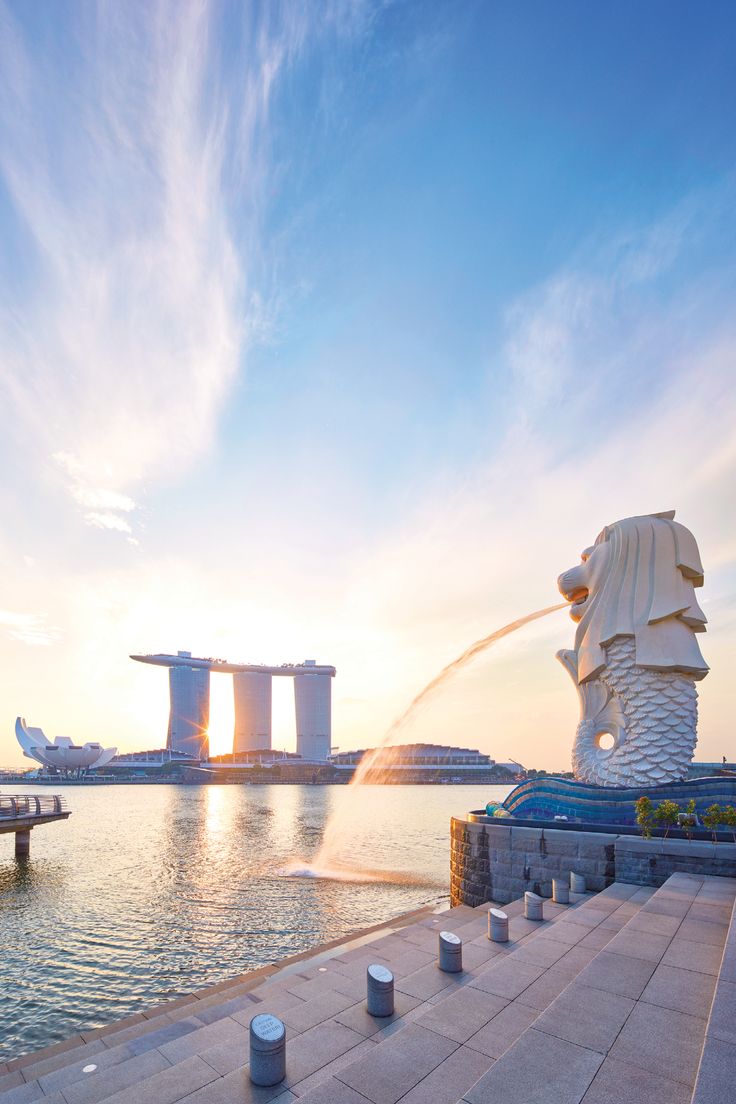
Unraveling the Lion City: The Legend Behind Singapore's Name
The name "Singapore" conjures images of a dazzling metropolis, a beacon of modernity in Southeast Asia. Yet, behind its futuristic skyline lies a rich tapestry of history and a fascinating origin story, beginning with a mythical creature: the lion. The very essence of Singapore's identity is encapsulated in its name, which derives from the Malay Singapura. This, in turn, is a loanword from the ancient Sanskrit Simhapura, a powerful compound of simha, meaning "lion," and pura, signifying "city" or "fortress." Thus, Singapore is quite literally the "Lion City."
This evocative moniker first surfaces in the Sejarah Melayu, or Malay Annals, a 17th-century chronicle that draws from centuries of oral traditions and historical records of the Malay world. The legend credits the naming to a Palembang prince named Sang Nila Utama. Around the year 1299, as the tale goes, the prince was on a hunting expedition when he sighted a magnificent, lion-like creature upon landing on the island. Believing this to be an auspicious omen, he named the settlement "Lion City."
Herein lies a captivating paradox: historical and zoological records offer no evidence of lions (Panthera leo) ever inhabiting Singapore or the broader Malay Archipelago. The natural habitat of these majestic beasts lies primarily in Africa and parts of India. So, what did Sang Nila Utama truly see? Perhaps it was a tiger, which was common in the region, or perhaps a completely different, less ferocious animal. More likely, the "lion" was a powerful symbol, a creature of myth embodying strength, royalty, and courage, perfectly suiting the ambitions of a burgeoning settlement. Regardless of the factual accuracy, the legend of the lion has deeply woven itself into the fabric of Singapore's cultural identity, providing a romantic and enduring narrative for its origins.
From Humble Beginnings: Singapore's Colonial Past and Road to Independence
While the legend speaks of ancient origins, the modern history of Singapore truly began in 1819. It was then that Sir Stamford Raffles, an astute agent of the British East India Company, recognized the strategic potential of this small island at the southern tip of the Malay Peninsula. Separated from Malaysia by the Straits of Johor and from Indonesia by the Singapore Strait, its location was ideal for establishing a crucial trading post along the bustling East-West maritime routes. Under British rule, Singapore rapidly transformed into a vibrant entrepôt, a hub where goods from across Asia and beyond converged, were exchanged, and redistributed.
The mid-20th century brought significant geopolitical shifts. After years of colonial administration, Singapore gained self-governance in 1959, marking a pivotal step towards full autonomy. However, the path to nationhood was complex. In 1963, motivated by economic and political considerations, Singapore merged with Malaysia, becoming one of its constituent states. This union, however, was short-lived. Irreconcilable political and economic differences led to Singapore's separation and, against immense odds, its declaration of full independence on 9 August 1965. This moment was not celebrated but rather marked by uncertainty and apprehension, as a small island nation, devoid of natural resources and surrounded by larger neighbours, faced the daunting task of forging its own destiny.
Forging a Nation: Lee Kuan Yew's Vision and Singapore's Economic Miracle
The post-independence era was defined by the extraordinary leadership of its founding Prime Minister, Lee Kuan Yew. From 1959 to 1990, Lee Kuan Yew spearheaded a transformative journey that defied all expectations. His vision, coupled with the People's Action Party's (PAP) consistent electoral dominance, laid the groundwork for Singapore's remarkable ascent. The PAP's philosophy, rooted in meritocracy, economic pragmatism, and social discipline, became the guiding principles for nation-building.
Key initiatives during this period were instrumental in Singapore's rapid development. Rigorous anti-corruption measures established a transparent and trustworthy governance system, which remains a hallmark of the nation today, scoring 84 out of 100 on the 2024 Corruption Perceptions Index. Compulsory education ensured a skilled workforce, while ambitious public housing initiatives provided affordable homes for the majority of the population, fostering social cohesion. Market-oriented reforms attracted foreign investment and fostered a competitive business environment. This strategic combination propelled Singapore's economy from its entrepôt origins to a global financial hub, a manufacturing powerhouse, and a vital logistics center. With a nominal GDP per capita of approximately $94,000 in recent estimates, Singapore now stands among the world's wealthiest nations per capita, a testament to sustained high growth rates and remarkably low unemployment. To delve deeper into this incredible transformation, explore From Trading Post to Global Hub: Singapore's Economic Ascent.
A City of Order: Governance, Laws, and Social Discipline
Singapore's political landscape is characterized as a parliamentary republic with a unicameral parliament and an executive led by a prime minister. The People's Action Party has maintained political dominance since independence, securing consistent electoral victories based on its track record of delivering stability and prosperity. This stability is underpinned by a distinctive approach to governance and social order.
Defining characteristics of Singaporean society include stringent laws designed to enforce social discipline. These laws, which include caning for vandalism and capital punishment for drug trafficking, correlate with some of the lowest crime rates globally. While these measures are credited with creating a safe and orderly environment for its 6.11 million people (as of June 2025), they have also drawn international scrutiny for limiting certain civil liberties, such as free speech and assembly. This unique balance between strict regulation and remarkable prosperity is a central aspect of understanding the nation's identity. For a deeper dive into this fascinating contrast, read Singapore's Paradox: Strict Laws, Low Crime, and Global Prosperity.
Singapore Today: A Global Crossroads and Thriving Metropolis
Today, Singapore stands as a vibrant, multicultural island city-state, a testament to strategic foresight and relentless development. Its strategic location at a key maritime chokepoint, coupled with continuous infrastructure investments, has solidified its role as a crucial node in global trade and logistics. The nation continues to attract multinational corporations, fostering economic resilience amidst global trade fluctuations and supporting a diverse population, including 4.20 million residents and non-resident workers crucial to its labor-intensive sectors.
Beyond its economic prowess, Singapore is a dynamic cultural melting pot. Its rich heritage is evident in its unique architecture, from colonial-era buildings to futuristic marvels like Marina Bay Sands and the Supertrees of Gardens by the Bay. The culinary scene is world-renowned, offering a kaleidoscope of flavors influenced by Malay, Chinese, Indian, and Western traditions – from hawker center delights to Michelin-starred dining. Exploring Singapore means experiencing a seamless blend of tradition and innovation, where ancient legends coexist with cutting-edge technology. When you visit, be sure to immerse yourself in the historical districts of Chinatown, Little India, and Kampong Glam to witness its vibrant cultural tapestry firsthand, and don't miss the chance to sample the diverse and delicious hawker food that is an integral part of its identity.
From the mythical roar of a lion to the bustling reality of a global powerhouse, Singapore's journey is one of resilience, strategic vision, and relentless progress. It is a nation that has not only defied geographical limitations but has also forged a unique identity, blending ancient legends with a future-forward outlook. The Lion City remains a compelling narrative of how a small island can achieve extraordinary heights on the global stage, continually evolving while staying true to its remarkable origins.